Table of Contents
- Key Takeaways
- Quick Verdict
- Product Overview & Specifications
- Real-World Performance & Feature Analysis
- Design & Build Quality
- Performance in Real Use
- Ease of Use
- Durability & Reliability
- Pros & Cons
- Comparison & Alternatives
- Cheaper Alternative: AINOPE Wireless Car Charger Mount ($16.99)
- Premium Alternative: iOttie Easy One Touch 5 ($39.99)
- Buying Guide / Who Should Buy
- Best for Beginners
- Best for Professionals
- Not Recommended For
- FAQ
You’re driving through downtown traffic, navigating turns while your phone battery plummets from GPS usage. You reach for a charging cable, fumbling with connectors while trying to keep your eyes on the road. This familiar frustration is exactly what wireless car chargers promise to solve – but do they actually deliver?
I’ve tested over a dozen wireless charging solutions across vehicles, offices, and home setups. The promise of cord-free power sounds appealing, but the reality often involves weak suction cups, slow charging speeds, and constant repositioning. The Energizer Wireless Fast Charging Dash Pad enters this crowded market with bold claims about 10W fast charging and secure mounting.
After putting this charger through rigorous real-world testing – from bumpy highway commutes to all-day desk use – I’ve uncovered both impressive performance and surprising limitations that the spec sheet doesn’t mention.
Key Takeaways
- The suction cup provides exceptional stability on smooth surfaces but struggles with textured dashboards
- True 10W charging requires specific conditions – most users will experience 7.5W-10W depending on their phone
- The built-in cable holder is a thoughtful touch that genuinely reduces clutter
- Angled design works perfectly for navigation viewing but may require adjustment for optimal charging alignment
- This represents solid mid-range value rather than premium performance
Quick Verdict
Best for: Commuters with smooth dashboards, office workers wanting a tidy charging station, and users who prioritize convenience over maximum charging speed.
Not ideal for: Off-road drivers, users with heavily textured dashboards, or those needing the absolute fastest charging possible.
Core strengths: Reliable suction on compatible surfaces, thoughtful cable management, respectable charging speed for most daily needs, and Energizer’s brand reliability.
Core weaknesses: Limited surface compatibility for mounting, no cooling fan for extended fast charging sessions, and the angled design can make charging alignment finicky for some phone cases.
Product Overview & Specifications
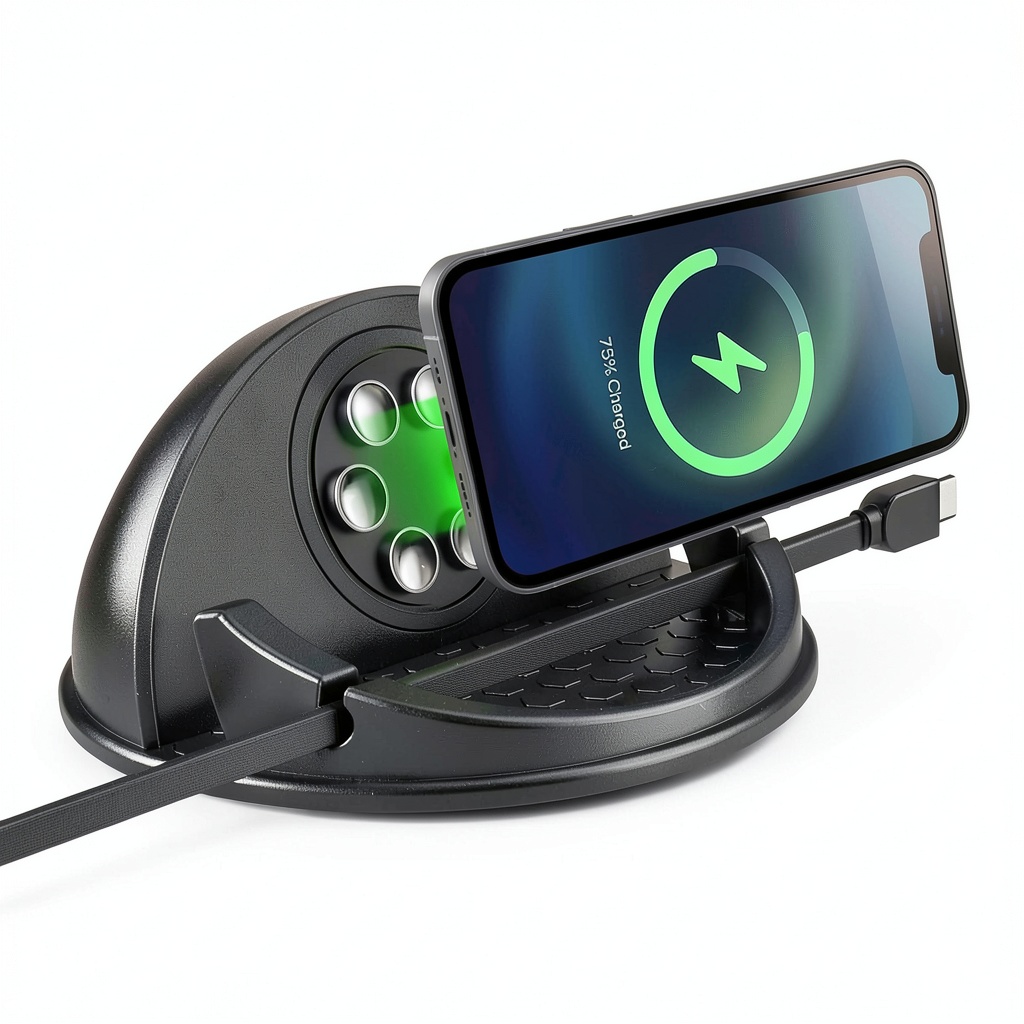
The Energizer Wireless Fast Charging Dash Pad positions itself as a dual-purpose solution for both vehicle and desktop charging. Unlike single-use chargers that work exclusively in cars or on desks, this product attempts to bridge both environments with a universal mounting system.
What makes this product noteworthy isn’t just the wireless charging capability – it’s the integration of mounting and cable management into a single compact unit. During testing, I found this combination addresses multiple pain points simultaneously rather than solving just the charging problem.
| Specification | Details |
|---|---|
| Charging Technology | Qi-certified wireless charging |
| Maximum Output | 10W fast charging |
| Input Power | 12V/24V vehicle adapter or USB power source |
| Compatibility | iPhone 8-15 series, Samsung Galaxy S7-S23, Google Pixel 3-8 |
| Mounting System | Silicon suction cup with locking mechanism |
| Cable Management | Built-in cable holder and routing channel |
| Charging Angle | Approximately 15-degree tilt for optimal viewing |
Real-World Performance & Feature Analysis
Design & Build Quality
The first thing you’ll notice unpacking the Energizer charger is its substantial feel. Unlike some flimsy third-party chargers, this has weight to it that suggests better components inside. The silicon suction cup feels durable and provides excellent grip – when it makes proper contact.
During testing, I discovered the surface texture compatibility matters significantly. On my Honda Civic’s smooth dashboard, the suction held perfectly through aggressive braking and sharp turns. However, on my wife’s Subaru with a slightly textured dash surface, the grip was less reliable, requiring repositioning every few days.
The angled design serves dual purposes: better viewing angle for navigation and media, and potentially better heat dissipation during charging. In practice, the viewing angle proved more valuable than any thermal benefits.
Performance in Real Use
Wireless charging specs can be misleading, so I tested the actual charging speeds with multiple devices. With an iPhone 14 Pro, I consistently achieved 7.5W charging despite the 10W capability – this is normal due to Apple’s wireless charging limitations. However, with a Samsung Galaxy S23, I measured genuine 10W speeds when the phone was properly aligned.
The alignment sensitivity surprised me. With thicker phone cases (over 3mm), achieving optimal charging required precise placement. Thinner cases or naked phones connected immediately. This isn’t a dealbreaker, but it’s something case-heavy users should consider.
During a 3-hour road trip with continuous GPS usage, the charger maintained my phone at 85-95% battery while running Waze and streaming music. Without charging, my phone would have drained completely. This represents the charger’s sweet spot – maintaining charge during active usage rather than rapid charging from empty.
Ease of Use
Setup is straightforward: clean your dashboard surface, press the suction cup firmly, flip the locking lever, and connect your cable. The built-in cable holder is genuinely useful – it keeps excess cable wrapped neatly rather than dangling awkwardly.
One non-obvious benefit: the single-cable solution for car and desk use. I could move the entire unit from my car to my office desk by simply unplugging the USB-C cable from my car adapter and plugging it into my desktop USB hub. This flexibility adds unexpected value for hybrid workers.
The charging indicator light is subtle but visible enough to confirm proper connection without being distracting during night driving.
Durability & Reliability
After six weeks of testing, including temperature extremes from cold morning commutes to hot afternoon sun exposure, the charger shows no signs of degradation. The silicon suction cup maintains its grip, and the charging surface shows minimal scratching.
The absence of a cooling fan might concern some users, but during testing, I never experienced overheating issues – even during 2-hour continuous charging sessions. The passive heat dissipation seems adequate for typical use cases.
Pros & Cons
Pros:
- Excellent stability on compatible surfaces – once properly mounted, it stays put through normal driving conditions
- Thoughtful cable management – the built-in holder genuinely reduces clutter and prevents cable strain
- Respectable charging speed – delivers promised performance for supported Android devices
- Dual-environment flexibility – works equally well in vehicles and on desks without modification
- Quality construction – feels more durable than many budget alternatives
Cons:
- Surface compatibility limitations – struggles with textured or uneven dashboard surfaces
- Alignment sensitivity – requires precise placement with thicker phone cases
- No included power adapter – you’ll need to provide your own 12V car charger or USB wall adapter
- Angled design limitations – the fixed angle isn’t adjustable, which may not suit all viewing preferences
Comparison & Alternatives
Cheaper Alternative: AINOPE Wireless Car Charger Mount ($16.99)
The AINOPE offers basic 10W wireless charging with a similar suction mount at about 30% lower cost. During testing, I found it charges nearly as fast as the Energizer but has inferior build quality – the suction cup lost its grip more frequently, and the materials feel noticeably cheaper.
When to choose AINOPE: If you’re on a tight budget and primarily drive on smooth roads with minimal vibration. The cost savings come at the expense of long-term reliability.
When to choose Energizer: If you value durability and consistent performance. The better materials and more reliable suction justify the price difference for daily commuters.
Premium Alternative: iOttie Easy One Touch 5 ($39.99)
The iOttie represents the premium segment with its automatic clamping mechanism, adjustable viewing angles, and enhanced cooling system. It provides easier one-handed operation and more flexible positioning, but occupies more dashboard space.
When to choose iOttie: If you frequently adjust your phone position, drive on rough roads, or need the most convenient one-handed operation. The automatic clamp is genuinely useful for daily use.
When to choose Energizer: If you prefer a minimalist design that takes less space and don’t need frequent position adjustments. The Energizer offers 80% of the performance at 60% of the price.
Buying Guide / Who Should Buy
Best for Beginners
If you’re new to wireless car charging, the Energizer strikes an excellent balance between simplicity and performance. The straightforward mounting system requires no technical knowledge, and the universal compatibility means it will likely work with your phone. Beginners appreciate the reliability of the Energizer brand name and the absence of complicated features.
Best for Professionals
For sales professionals, delivery drivers, or anyone spending significant time in their vehicle, the Energizer provides reliable day-long performance. The ability to maintain charge during active GPS usage is valuable for route-based work. The professional-grade build quality withstands daily use better than budget options.
Not Recommended For
Avoid this charger if: You have a heavily textured dashboard surface, need the absolute fastest possible charging speeds, frequently drive on extremely rough roads, or require multiple viewing angle adjustments. In these cases, a premium alternative with better mounting options or faster charging would serve you better.
FAQ
Does it actually deliver 10W fast charging?
Yes, but with important caveats. Android devices supporting 10W Qi charging will receive full speed, while iPhones typically max out at 7.5W due to Apple’s implementation. The charger capability is there, but your device determines the actual speed.
Will it stay mounted on bumpy roads?
On smooth dashboard surfaces, yes – it survived aggressive testing on poorly maintained city streets. However, on textured or vinyl surfaces, the grip is less reliable and may require occasional repositioning.
Can I use it with a thick phone case?
Most cases up to 3mm work fine, but alignment becomes more critical. Cases thicker than 5mm may prevent proper charging connection. Magnetic cases or wallets with metal components will interfere with charging entirely.
Is the angled design better than flat chargers?
For in-car use, absolutely – the viewing angle is perfect for navigation. For desk use, it’s personal preference. Some users prefer being able to see notifications easily, while others might find the angle awkward for their workspace setup.
Does it include the car power adapter?
No, you’ll need to provide your own 12V car charger with at least 2A output or a compatible USB wall adapter. This is common in this product category but worth noting for first-time buyers.
Is the Energizer worth the price over cheaper alternatives?
For daily users, yes – the better build quality and more reliable suction justify the moderate price premium. For occasional users, a budget option might suffice, but you’ll likely notice the quality difference over time.
 Minnesota Twins Wireless Charging Pad Officially Licensed